We Laughed, Then We Cried – Yehdahm Kweon and Rebecca Kim

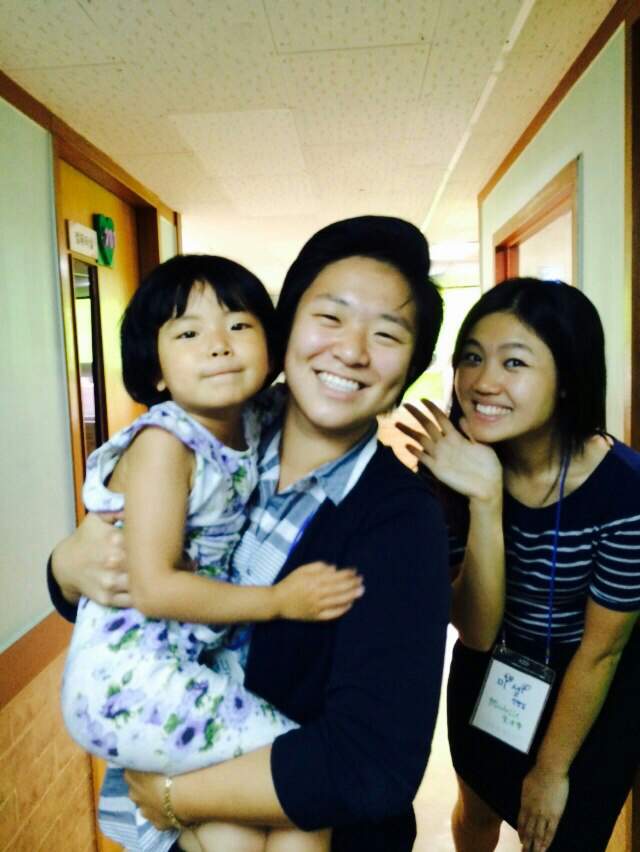
Our last few days in Korea have been bittersweet. There have been many goodbyes, hugs, and well wishes. It is hard to believe that two full months have gone by. Looking back, we have come a very long way and made lots of progress. Our last day at KumKang was on Thursday. We had a slideshow of the pictures that were taken over the past two months, and had a small pizza party with the students. It is amazing how close we have gotten with the kids; we were even able to see some students blossom from shy to energetic and excited. There was lots of energy at KumKang School that day. Many of the students do not have much stability or consistency in their day to day lives. Even in the short time that we have been there, we have seen multiple forms of volunteers come in and out of the school. Although a relatively short volunteer program will not solve the entire issue of the reunification of the Korean Peninsula, it is one small step in understanding the situation in depth, and spreading awareness about it. In the case of Kum Kang School, some volunteers place a label on the students as “North Korean Refugee Children” which ultimately sounds like a charity case. However, a big lesson that we all learned during our time here is that these children are just like any other kids. They throw tantrums, play games, and can be better actors than professional athletes.

10555045_4325398430130_2077619404_n 10544826_4325398470131_1138192466_n 10566496_4325398590134_686230506_n

And though we’ve said our goodbyes, it certainly doesn’t mean it is the end. What we established in the two months of learning and working with these students is the very first of hopefully many meetings between Duke students and KumKang School. Perhaps the program will develop to have a structure penpal system so that the students and the student-teachers can keep in touch. And maybe the difficulties faced and mistakes made in this first trial will be fixed in joint effort in coming years. We leave with high hopes for the following summer and the incredible experience of learning from the students as much as they learned from us.

10569127_4325398550133_1403671992_n 10543256_4325398390129_964364955_n 10569216_4325400070171_1256837139_n 10543699_4325398510132_1314834955_n

DESK Week 7 – Anna Olekanma

Role Playing!!

Throughout our time at Kumgang school, we’ve noticed that our students, like any other kids their age, tend to play a little rough. So with only two weeks left here, Team A decided to try something new. While writing up our lesson plans for the last two weeks of class, we added a new activity called role playing. We designed our role playing to consist of different situations that the students come across in their daily lives. We would then describe the situations to the students and then ask them what they should do and what they should not do in that situation. After answering correctly, the teachers would then act out a short version of the situation with polite language and then after that we would allow the students to act out the scenes as well. For example, we used situations such as what to do when one student accidentally pushes/hits another student, how to say please and thank you, how to ask for help in certain situations etc. When we tried out role playing for the first time, it worked out better than we thought. The students were actively engaged and they understood that it was better to handle a situation politely rather than angrily. They definitely had the most fun acting out the situations and even asked for more scenes! However,as the teachers, we were worried that the children were just having fun with the acting and not actually incorporating them into their behavior. However, one day we happened to be doing role playing and while acting, a student accidentally hurt another student. Surprisingly, the student apologized and the injured student quietly accepting without retaliating, as they would have done before. After seeing the peaceful resolution of that real life situation and the change in the children’s behavior since we starting role playing, it feels especially good to know that as teachers we are able to leave small life lessons behind for the students. We also found a better way in getting the students to actually participate in class!

National Museum of Korea

From the large site of the National Museum of Korea

From the large site of the National Museum of Korea

IMG_0758

For this Friday’s excursion, we had the opportunity to meet the very talented fresco painter Jin Young-Sun, who also taught two art classes at Duke last semester. After a brief introduction into different art styles found in Korea from ancient times to the present, we were able to explore the exhibits at the National Museum of Korea, which holds many of Korea’s national treasures. On a guided tour through the museum we were taken through the astounding art of the first ancient three kingdoms of the Korean Peninsula, then introduced to art from the neighboring regions in China and Southeast Asia, which included the magnificent 6th-century statue of the Pensive Bodhisattva and many other ­Buddha statues. Beside each section in the museum, there were tutorials placed nearby that showed the long processes that took to make each ceramic bowl, or Buddha statue, or painting, etc. So while walking through these wonderful exhibits of gold statues, delicate ceramics and calligraphy, we were able to learn to really appreciate the hard work and time that was put into each piece and every little intricate detail. Surprisingly we also learned that it was not Johannes Gutenberg who first created the movable metal type printing press! China invented the first movable type printing technology, while Korea then invented the first movable metal type printing technology and then Gutenberg invented the improved movable metal printing press in Europe nearly 80 years later. For Professor Jin, this is an important clarification that she is currently trying to spread. This trip was definitely as nice detour from the topic of unification and just more about the history of Korea through its art over time.

IMG_0748 IMG_0747 IMG_0744

A golden crown from the Silla exhibit at the museum

A golden crown from the Silla exhibit at the museum

Professor Jin Young-Sun

Professor Jin Young-Sun

A painting from Professor Jin

A painting from Professor Jin

Gaining insight into Korean art history from Professor Jin

Gaining insight into Korean art history from Professor Jin

Checking out some exhibits at the National Museum of Korea

Checking out some exhibits at the National Museum of Korea

Dialogues. – Won-Ji Lee

The progress with most of the Chinese-speaking students is continuing at a steady pace. However, one of the students was in a bad mood and completely shut down on Monday morning. After multiple attempts to get her to start her work, we left her alone for most of the morning; however, towards the afternoon, she bounced back and whizzed through her reading. I realize that even this late into the program, these kinds of phases can happen and that the best thing to do is just leave her be until she is ready to learn.

With the older 4th and 6th grade students, we continued to review the English alphabet, as many of them still get confused over certain ones. Playing games like Bingo and fly swatter, we are hoping to fill in these holes in their English knowledge in a fun and interactive way. We are also gravitating toward a more artistic direction with the students to give them a physical final product before we leave them at the end of our program. We mentioned that we will be leaving them in less than two weeks, and were greeted by some a variety of responses. Half of the class gave us blank stares and the other half were cracking jokes about it with a laugh. I am personally conflicted about this reaction. It is relieving to see the students who were laughing about it, as it hopefully means that saying goodbye will not be as hard. But it is simultaneously saddening because perhaps it means that we as teachers, did not make enough of an effort to reach out and connect with these students. For the kids who gave us blank stares, although we do not know what was going on in their minds, I am also hoping that saying goodbye to them will not be difficult. Towards the end of the day, we had to confront one of the older students about bullying his classmate. As we were playing a game he suddenly threw a younger classmate on the ground for being in his space. After class, we lectured him on the principles of treating others with respect and how important that will be later on in life. The brashly confident 6th grader was a different person when being lectured. His head was down, would not make eye contact, and was dead silent. Although he did not say a word, we are hoping that our words reached him at least a little bit. Even approaching the final days of the program, we are still faced with both new and old problems.

On Wednesday evening, our group attended Dialogue in the Dark. Though unrelated to our work at the school, this was a surprisingly powerful experience. We were able to catch a glimpse of what it means to be blind. For a 90-minute walking tour, we were accompanied by a blind “roadmaster” through pitch blackness. We navigated through simulations of a forest, a busy road, a food market, rode a “motorboat,” and tasted some soft drinks in the absolute darkness. We tried to guess what our soft drinks were, but were corrected by our roadmaster, who could tell the differences between soft drinks by their smell and the size and shape of the can! When we first entered the tour, many of us were nervous and scared, but by the end, our roadmaster’s hearty laugh and reassuring voice made the darkness into something comforting.

The crew at Dialogue in the Dark

The crew at Dialogue in the Dark

Group photo from Dialogue in the Dark

Group photo from Dialogue in the Dark

DESK Week 6 (Part 2) ~ Drew Korschun

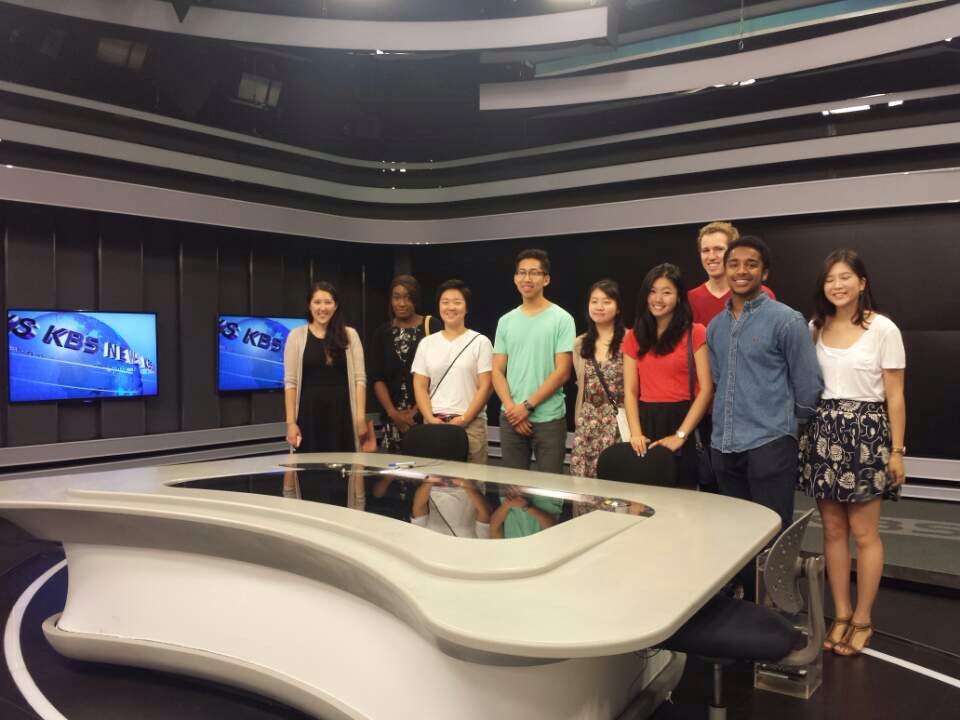
Our team in the KBS newsroom!

Our team in the KBS newsroom!

Talking to Reporter Park over lunch at KBS

Talking to Reporter Park over lunch at KBS

Girl group f(x) performing at Music Bank!

Girl group f(x) performing at Music Bank!

This past week has been one of reflection, troubleshooting, and projecting forth how we aim to bring the program to an end. We talked as a group about some of the problems we’ve been facing in the program in our plans for teaching at the school, and we’ve also discussed some ways we can move forth in solving these issues and making our work more meaningful, impactful, and efficient.

Some of the things we came up with that have been daunting or difficult include the following. 1) Problems we come across with the administration. There are a lot of communication gaps about expectations and about certain events we try to tell about. Also, we’ve noticed that sometimes the admins leave at (albeit short) periods of time without notifying us. We realize that some issues with administration aren’t exactly something our group can change, but it’s something to be aware of for next years’ DukeEngage groups. 2) Behavioral problems and a system of reward and punishment. We were mentally aware that there were going to be some behavioral issues to look out for, but we weren’t necessarily equipped with the knowledge about how to handle them. Team A decided to go through role-playing exercises to work out positive solutions to problems with the students. Both teams have talked about creating opportunities for rewards (candies, stickers, playing dodgeball), but we didn’t create a strict system. 3) Language barriers. Obviously this was a significant challenge but we feel like we had a good ratio of people who knew Korean well and people who could communicate in Chinese. 4) The efficiency of our teaching, or the lack thereof. Is what we’re doing working, and will it stick? Homework help with math is always going to be relevant, but sometimes we worry that teaching sections of English vocabulary are not going to stick easily, and we haven’t focused too much on actual English speaking or conversation, which we know most of the kids are capable of in the right environment. Trying to apply good teaching methods as well as the charisma to interest the class is a challenge, for sure.

On another note, Team B (Usman, Christine, Won-Ji and I) had the experience of going to the Japanese Embassy in Gwanghwamun area, where there is a weekly hour-long demonstration calling for official governmental apologies over the Japanese Empire’s systematic sexual slavery of women in various Asian countries during World War II (the women who were known as “comfort women”). The embassy was not big or glamorous, but it was lined with South Korean police who were prepared to guard it if necessary. The demonstration was not groundbreakingly huge, but it had a very decent number of people present to support and/or observe. There was at least one halmoni (Korean for grandmother) there who suffered through the experience of being a “comfort woman,” and there were impassioned speakers, a choir of singers, and people holding signs. I had read about the issue, but it was quite different seeing it from the light of this protest.

Afterwards, we ate lunch at a Korean restaurant in nearby Insadong and then had delicious patbingsu (sweet shaved ice) with Professor Kim. After this, we rode back to Hongdae to see a museum that centers around the history of the Japanese Empire’s “comfort women” and women’s human rights around the world. The museum experience was informative, but it also presented the material in a way that let the viewer try to understand the sheer trauma of the history and how the trauma lasted silently for half a century in Northeast Asia. It also encouraged the viewers to connect with the stories of many particular women and to share in their humanity through the narratives they gave.

Overall, the week was a light one for Team B, but we enjoyed working with our students. We had them do a creative project each day – on one day we learned how to draw Olaf the Snowman from Frozen, on another we had the kids draw a place in the world they wanted to visit, and we also made origami flowers with them. Math homework help was fairly standard and fairly difficult to teach as always (although learning math in a different language has been a very fun challenge for me). English is always particularly fun to teach, but we focused quite a bit on the phonetics of English and the alphabet and its strange sounds and exceptions to the rules, so we hope that it kept the kids’ interest and stuck with them.

On Friday, we also had the privilege of getting a private tour of KBS (Korean Broadcasting System) at their studio location in Yeoeuido (that’s a lot of vowels when you romanize it…). The building itself was phenomenally huge and glamorous, and during the tour we were able to see some news rooms and rooms for particular shows such as for the 2014 World Cup. During lunch we got to meet with Reporter Park, who is KBS’s only reporter who is a North Korean defector. We had a really great time listening to her many stories about her life in North Korea; we learned that she graduated from the top school Kim Il-Sung University, and she told us about her worries for her family who still live in Pyeongyang. She debunked a lot of misconceptions about the nation when she told us about her mostly (or comparatively) well-off life and her belief in her own freedom of action. She told us about enjoying college life, about working and studying hard, and she was even kind enough to tell us some shy details about her ex-boyfriend. We enjoyed a really delicious lunch of bibimbap and various side dishes, and we enjoyed what was a very worthwhile and fun conversation.

After the tour of KBS and lunch, we also had the privilege of seeing a live recording of Music Bank, a music ranking show that hosts lots of the latest and hottest K-pop stars. We got to see f(x), a girl group that is quite well established already, and we also got to see some up-and-coming boy bands, including GOT7 and 100 Percent. It was a great experience to see the dancing and listen to their live performance, all the while cringing at the screams of their fans. We were and are certainly privileged to have the connections to be able to meet the reporter and to see behind-the-scenes footage, and this day just added on to the list of things that we are already privileged in. Our hope is that such privilege does not distract from our other duties – teaching and building relationships with the students – and we’ll do our utmost to stay true to all the things we are committed to in the following week.

After a restful weekend, let’s look forward to a fun and productive week at Kumgang School! Bye y’all, and thanks for reading.

DESK Week 6: Finding Direction – Jina Yun

In terms of teaching this week, we tried something new!

First, we mixed up the morning group by switching out the members from Team A and Team B.  We made sure to have a fluent Korean and a Chinese speaker in each group, in order to maintain the efficiency of the groups.  On Monday, four of us went in for the morning class with the Chinese speaking students as usual.  Some of us were initially worried that the students might be confused by the new group of teachers, but the students did not seem surprised at all and were just excited to see us again.  The new team of teachers worked well together to support each other in teaching the Chinese speaking students.  However, despite how well the teachers collaborated, the students seemed to be in an off mood.  The two sisters who usually stick together and look out for each other were fighting over a pencil to the point where one of them started crying.  I think it was shocking for most of us to see that kind of scene between the two sisters.  The first day when they arrived at 금강학교, they were both quite shy and innocent and seemed to just want to make new friends.  Back then, we would have never imagined them fighting each other.  This also shed light on how emotionally tolling their time at the school must be.  Being anywhere from 6-14, these students rarely get to see their parents, so it is no surprise to us by now that their moods are unstable and easily affected.  However, we tried our best to make sure that the two sisters made up and that there was peace in the class again.

Second, we tried a role playing lesson in class.  We noticed recently in class that some of the kids bully each other a lot.  The kids are not only still pretty violent with each other, but have a hard time saying please, thank you, and sorry to each other.  While we believed that academics is still important, we thought that learning appropriate mannerisms was a priority for these students, and thus tried to implement this role playing activity.  We started by presenting a scenario that the students commonly see and asking them what the appropriate response would be.  The first time we tried the role playing activity, it was not very successful because we tried to do it right after the students fought with each other.  The students were completely reluctant to play with each other and seemed quite upset at us for lecturing them for their behavior.  However, when we tried it a second time, they were more willing to to participate.  They seemed to find the activity amusing and some of the kids were enthusiastic to act out each scene.  In fact, some of them wanted to try to act out the scenario with some of us, further attesting to how close we have gotten to the students during our time there.  Even though the students might have simply participated because they found it amusing, we thought that this lesson was a good exposure to appropriate responses and behavior.

Having already taught at 금강학교 for 5 weeks, we now ask ourselves the question: what is our goal?  Before starting the program, we initially wanted to focus on getting to know the students on a deeper level and hearing their stories.  However, when we started talking, the school administrators had another direction in mind, and we ended up focusing more on academics with the students.  Now with two weeks in mind, what do we want the kids to get out of our time here?  What do we want to earn from our time here?  While not forgetting the importance of academics for these students, we still wanted to provide a setting for these students to express themselves. In order to do that, we decided to implement more art lessons such as drawing, crafts, and origami in order for the students to not only have a creative plug, but also for them to have a physical final product.  We hope that by the time of our leave, the students can have gained something from us, for we have already gained so much from them.

Gaining New Insights: Visit to the United States Embassy – Usman Mahmood

When North Korea is mentioned in the United States, there is usually a certain stigma surrounded the subject of this country regardless of the context it is mentioned in. The country is constantly negatively perceived as the “bad guy” due to the closed-off dictatorship headed by Kim Jong Un and its provocative actions concerning nuclear weapons. Thus, the media in the United States and many other countries around the world spend a large amount of time on its discontent with North Korean actions rather than the prospect of unification with South Korea, a people of the same history and culture who have been split for more than 63 years.


Some of the group out in front of the American Embassy

Some of the group out in front of the American Embassy

Statue of King Sejong near the embassy. The most respected king of the Joseon dynasty and the creator of Korea's alphabet.

Statue of King Sejong near the embassy. The most respected king of the Joseon dynasty and the creator of Korea’s alphabet.

IMG_0675

Throughout our stay here in Seoul, we have had the privilege of hearing different perspectives on the prospect of unification. At the Institution for Unification Education during the first week of our trip, we were able to gain insight into the steps that South Korea is taking toward reunification, South Korea’s current and past relationship with North Korea since the divide, and the role of international players, specifically India and Pakistan on the reunification process. A few weeks later, we attended another series of lecture that provided a different look on unification such as in-depth analysis of the economic implications of unification. However, up until our trip to the United States Embassy we had not gained a detailed American perspective on unification or the relationship between North and South Korea, which is relevant to our group as students who live in the U.S.. After going through a series of security measures at the embassy located in Gwanghwamun, we were fortunate to have a talk with Daniel Tikvart, an specialist in North Korean relations who prior to working at the embassy served as North Korea Unit Chief in the Office of Korean Affairs at the U.S. Department of State. Throughout the talk with Mr. Tikvart, we gained insight into the United States’ role in South Korea, specifically their military agreements and compromises to support South Korea against North Korea in addition to the role America has played in supporting the North Korean refugees who need to be integrated into South Korean society. Another major point of the lecture was the United States’ role in unification as a country that would be integral to the process along with Japan, China, and Russia. Due to the immediate costs that unification would generate, foreign powers such as the United States will need to play some kind of role without excessive interference, as the issue should be resolved under the terms of the two Koreas.


Statue of Admiral Yi Sunshin, in Gwanghwamun Square

Statue of Admiral Yi Sunshin, in Gwanghwamun Square

Changing of guard ceremony at Gwanghwamun Palace

Changing of guard ceremony at Gwanghwamun Palace

As a whole, the lecture was captivating as it provided our group with a new perspective, one that is often over-shadowed in the United States by the constant negative press concerning the North Korean government. Despite the occasional American bias, which was anticipated with regards to the North Korean government and a unified Korea under a liberal democracy, the lecture gave an objective explanation on America’s role in the relationship between North and South Korea.

Lunch at a Chinese restaurant after the embassy

Lunch at a Chinese restaurant after the embassy


DESK Week Five: Moody Monday – Michelle Dang

So far during our time at Geumgang School, we focused on getting to know the students and understanding their personalities and interests. However, it is clear to us now that there are a few students who consistently refuse to focus in class and distract their fellow classmates instead. Furthermore, at times a student may say something insensitive or offensive, but refuse to apologize. As teachers, we have the responsibility to respond accordingly if a student behaves – but we are also unsure of what type of discipline to enforce. On Monday, three incidents occurred that tested our ability to react appropriately to misbehavior.

1.

On Monday morning, Team A worked with the Chinese-speaking students as usual. In the past the mornings have always been very smooth since we can work with the students one on one and keep the students focused. However, one student kept complaining and did something that was offensive to one of us. She knew that what she had done was wrong – but when I told her to apologize to the teacher, she refused and stormed off instead. I ran after her to figure out why she didn’t apologize. Talking to her, I realized that she had no concept of the power of an apology. For her, an apology was just a superficial verbal announcement that had no meaning. On the other hand, we have it drilled in our heads since we were young that if we did something wrong and genuinely apologized, we would be forgiven. After this incident, we realized the students at Geumgang School probably weren’t aware of the importance of apologies, which explained why students find it difficult to resolve arguments they have with each other. Though I was able to eventually convince her to apologize, she only did so halfheartedly.

2.

There is one student who comes in the afternoon who has consistently refused to do the work assigned – instead, she would either distract other students or rest her head on the table and sleep. On Monday, again she came in and simply slept, refusing to participate in the English lesson. We clearly said at the beginning of class that if the students did well we would let them play dodge ball for the next period, so even students who were usually reluctant to participate were attentive. Hence, when the next period began and she was about to leave to play with the other students, we told her to sit silently in the classroom by herself because she didn’t earn the privilege to play. She began crying, but we wanted to be stern so that she realized we were seriously disappointed by her behavior in class. After around 20 minutes, she had to leave for a music lesson.

3.

There is one student in our afternoon class who tends to be a little aggressive when he jokes around with his classmates. Unfortunately, on Monday his joke went too far and he actually hurt another student. The student who was hurt, one of the older Chinese-speaking students, began shouting profanities at him and was close to hitting back. We stepped in before they could actually start a fight, and scolded both of them – the student who was jokingly hitting people should stop being so reckless and realize he was hurting others, but the Chinese-speaking student also retaliated in a way that was inappropriate. Instead of screaming at the perpetrator, which doesn’t resolve the underlying issue, he could have talked to a teacher to help him. We wanted all the students to know that they didn’t have to handle these arguments on their own, and that we were there to support them.


After these three incidents, Team A was exhausted and a little disheartened. However, after a group discussion, we came to the conclusion that perhaps we should change the direction of our teaching – instead of just teaching subjects like English and Mathematics, we could incorporate social learning as well. Next week, we will be hosting a role-play session, during which students will have to consider situations from different standpoints and understand how to resolve problems between friends and classmates. Though this may be very ambitious, we hope that by the end of our time in Korea, the students will have learnt to reconcile with each other using more positive methods.

Week Four: Touch and Go and Something More – Rebecca Kim and Yehdahm Kweon

This week marks the halfway point for our Duke Engage experience. To be sure there have been plenty of ups and downs. For the most part, we’ve gotten used to the unpredictability of the school’s schedule and have begun to adjust appropriately on the go. And, getting comfortable and learning to problem-solve quickly gave us the opportunity to understand the students on a personal level.

Many of them, as mentioned before, spend most of the year away from parents and family without the affection or care that come with family and support. So, seeing these students brighten up or enjoy our presence was both rewarding and worrying. More than anything, these students really seemed to want attention, whether through encouraging comments on completing worksheets or asking curious questions. Many of them started to share parts of their day or their emotions that they felt even without prompting. Slowly I felt like I was familiar with their dislikes and likes, idiosyncrasies, and other traits that we couldn’t pick up earlier in our interactions. At the same time I didn’t know what our roles were really supposed to be here at Kumkang. We wanted to be supportive emotionally and pragmatically— in the academic aspects of the teaching— but kids could very much become attached. With some of the students, we spend close to eight hours together. The others as well, the more we share and communicate and listen, begin to ask if we are leaving, if we are coming back, when we will be coming back and so on. Even if the program continues, the same group of Duke Engagers will not be coming back to the school. These students’ questions have really made me question what our impact will be and what might be both the products and consequences left behind.

As we continue to teach and try our best to carry out the tangible goals week by week, we came across another difficult issue. Some of the students are very much receptive to the lessons and subjects, both math and English. And others, a few regularly dissatisfied students, refuse to participate. They do everything from crying, to throwing tantrums, to sitting silently and staring blankly until the break periods come around. This is both disruptive and severely inhibiting for the class progress, since we try and coax all of the students to participate. In some moments the pause that occurs while one of us tries to nudge one student to participate is enough to make another student lose interest. It isn’t that the students are always averse to learning, but that on some days they have dark moods, or are tired and decide not to participate, or particularly dislike the subject. When persuaded or engaged enough, each and every one of them are definitely willing to learn. But, with four inexperienced student-teachers to twelve to fifteen students, it can get hectic or slow in pace when three or four students don’t want to participate that day. While we want to cater to the student’s personal needs, time passes and the students fall further behind in comparison to the normative set in a South Korean school standard. Do we isolate the students who want to learn from those who are unwilling so that the few who do can make progress, at the expense of the learning of students who are less willing? Sometimes, we reach a point where the class just has to proceed even if some of the students sit with their heads down through the entire period.

Despite that, we have periods that all the students are engaged. We started small artistic exercises at the end of each week that are not necessarily academic but are just as important. The students are given blank paper and a prompt— perhaps ‘create an animal that doesn’t exist,’ or ‘describe your dream,’ or ‘imagine a universe of your own’— and given time to draw. At times, the students try and do the bare minimum. But once asked a few questions, it’s amazing to see how much imagination and human emotion they can bring into the things they create. Moreover, these exercises really seem to bring out the personal sides of the students, their interests, their dreams, and their story. They pull at us and call us over with ‘teacher, look at this’ or ‘teacher, look at what I drew!’ and describe to us every detail and the reasons why they made something in some way. Because of these moments, I wonder by the end of the week that maybe what we leave behind doesn’t have to be academic or pragmatic but something more. Maybe we could leave behind an understanding of self for the students with situations and personal histories that allowed little interest for their identities from both themselves and others around them.

After a week of teaching, we headed to Sokcho, a city northeast of Seoul that is known for its delicious sashimi and natural environment. We were warmly greeted by professors from Kyung Dong University, who showed us around the campus and presented lectures on the Sokcho region, which borders the eastern portion of the Demilitarized Zone (DMZ). Despite the painful memories it may bring back, or the historical “scar” it may be, the unoccupied DMZ region is home a rich ecological system, and helps to promote organismal diversity. Furthermore, it preserves the beauty of nature in something that symbolizes division and hostility.

10510246_4241224045823_2052060213_n 10485070_4241224125825_1409318462_n

During our trip, we were able to visit the border to view North Korea from afar. The actual trip itself was a lengthy process, and we had to go clear multiple security checks to drive to the viewing point.

Looking out toward the DMZ along the beach

Looking out toward the DMZ along the beach

We also visited the DMZ Museum, which houses artifacts from the Korean War and provides a thorough history on the division between North and South Korea. Despite the modern, luxurious face that South Korea may present, there are still many underlying political issues to be solved. As each year passes and Korea continues to move forward with technology and society, it is difficult to remember that Korea is technically still at war.

An exhibit from the DMZ museum

An exhibit from the DMZ museum

Learning more about the history of division helps us to get a better idea of the situation at hand, and brings up lots of questions in regards to community service. The issues of reunification and resettlement are not ones that can be solved overnight, or even within a year. But, it is interesting to learn and experience this on multiple scales, from tutoring refugee children to visiting the border that represents a painful past and continues to divide a nation. The frustrations we may encounter at Kumkang School are not problems that are easily fixable. But, taking a step back and observing helps us to realize that we aren’t here to make drastic changes. Rather, our community service is made piece by piece in little ways, such as providing encouragement and confidence or inspiring a mind to reach further. We’re getting there, slowly but surely. In the spirit of the World Cup, here’s to a fantastic second half!

Go Team Korea!

Hiking at Seoraksan

Hiking at Seoraksan

10503669_4241224085824_3494699_o 10486352_4241224005822_1405687113_n

Progress. – Won-Ji Lee

We had gone into Tuesday with the same openness and optimism to teach the kids, but were a bit disappointed to see that all but the Chinese-speaking students had not come in until around 4:30. The rest of the students apparently have a new after-school program arranged by the Kumgang School and the public school to attend, that helps with their homework. Although the timing of the start of this new program is unfortunate, we have discussed it with the Kumgang teachers, Professor Kim, and Professor Kwon and are hoping to sort out what we can do to maximize the use of our skills. It would be a disappointment if any of the potential manpower of each of our DukeEngage members, goes wasted. With the Chinese-speaking students, however, every period seemed to flow regularly and with relative consistency. It is amazing to think of just how close we have gotten to these kids after just a short week. The sheltered body language and cold, disapproving looks some of us experienced on the first day with the kids, have now dissolved into an openness. We are at the point now where we know the students’ temperaments, natural inclinations, tics, and the best ways to reach them. With every funny face we make, every word taught, and every goading scold, these relationships are becoming more and more real by each day. After continued lessons in English, and even singing One Direction songs, we said our goodbyes for another day. But as we were leaving, we were followed by one of the younger students who came to us in tears. As we picked her up, she explained that she was crying because she missed her mother. We wiped her tears and assured that everything was going to be okay. Personally, it was a hard reminder of just how real these students’ situations and our relationships to them are.

Later that day, we traveled to Ewha University and separated into four different groups to continue our Korean studies with Ewha University students, courtesy of Professor Kim’s “connections.” Our teacher was another Professor Kim, who was a very friendly Ph. D student. We learned some basic grammar and held some basic conversations. In the next weeks, we will be meeting in a classroom at Ewha, learning more Korean, travelling to the Han River, and even trying to learn some different Korean dialects.

Thursday, half of our group went to teach the Chinese-speaking kids for the morning and early afternoon. As I was reading a Korean text along with one of the students about Christopher Columbus, I had one of those mind-boggling moments, pondering the situation I was in. Here I was, a Korean American, translating a Korean text into English, so it could be translated into Chinese, about European history of the colonization of America, to a North Korean student raised in China, now learning in a school in South Korea. It’s amazing how our unthinkably convoluted paths can align for a couple moments in our lives. Other than these kinds of cliché thoughts popping into my mind, the rest of the day consisted of several fights breaking out between the students, ending up with one bursting out the door with tears. After attempting to comfort her in Korean and wiping her tears, we sent her off and had lunch. Later in the afternoon, the Chinese-speaking students continued their curriculum with the other half of our group and we worked on math with a handful of sixth grade students, as all of the other students went to the hospital to receive vaccine shots. With the help of one of the regular math teachers at Kumgang, we were able to help the sixth grade students really focus and hone their skills in long multiplication, long division, and mixed fraction addition.

Later that night, at the group reflection session, we discussed our thoughts this week. We have made great progress with the Chinese-speaking students, as they are consistently at the school when we are, but we are hoping to get the same kind of consistency with the rest of the students next week!

IMG_0548 IMG_0547 IMG_0546 IMG_0544 IMG_0545

Week 3: Fist Bumps and a Surprise Twist – Anna Olekanma

At 9 o’clock Monday morning, Team A started off our second week of teaching at the Kumgang school. Our morning proceeded on as usual, as we went through Korean languages exercises with the Chinese-speaking students. However the afternoon greeted us with quite a surprise. 2:40 pm hit and Team B arrived on time, however none of the students had returned from school. 3:00 passed, then 3:30 pm and in that time only two students had returned from the local public school. At 4:00 pm, we figured that rather than waiting for them, it would be better to ask the principal about the students’ whereabouts. Turns out, that she was also surprised that the students had not yet returned from school and so she decided to give the school a call. After inquiring about the situation, the principal explained that the school had started a new program for the North Korean students and that they would be returning late from school throughout the week due to testing. Throughout the week, the students trickled in little by little starting from 3:00 pm, which caused our classes to be overstaffed, often having 2 or 3 teachers to one student, which definitely helped in terms of being able to cater exclusively to each student and controlling the class atmosphere. This week we didn’t end up strictly sticking to our intended lesson plans because of the lack of students, however we found that the lessons that we were able to do, were very successful and were really able to get the kids engaged. It could be that our lessons were particularly good this week or that the students are now starting to feel more comfortable with their new foreign teachers. This week there was a noticeable increase in participation by the students and even in our relationships with the students. As you walk down the main hallway of the school, it’s encouraging to see several animated conversations and inside jokes between students and teachers and the occasional creative handshakes and high fives. In just two weeks, we, as teachers, have learned how to get the kids to pay attention and how to balance serious class time with fun activities. It has also become easier to deal with the random surprises that seem to pop up each day and adjust our plans when necessary. We have been able to learn from the students and the school administration just as much as they are learning from us.

On Friday, for our weekly excursion, we were the granted the opportunity to go to Seoul National University (SNU). It is comprised of sixteen colleges and six professional schools and is considered to be the top university in South Korea and approximately the fourth highest university in all of Asia. The university maintains several undergraduate exchange programs with foreign universities including Harvard, Yale, Duke, Stanford, UPenn, MIT, and Peking University. As we walked through the campus, I was taken aback by the size and beauty of the campus. The landscape was absolutely breathtaking and includes the Gwanaksan mountain as a lovely backdrop, with several ponds and innovative architecture. For the first couple of hours of our trip, we were hosted by the Institute for Peace and Unification Studies at Seoul National University (IPUS). The Institute primarily focuses on peace studies around the world and conducts many research projects that will ultimately provide insight into unification issues on the Korean Peninsula. According to SNU, IPUS concentrates on three dimensions: peace through inter-Korean reconciliation, peace through the promotion of cultural and human rights, and peace through ecological civilization. We were able to listen to lectures by three professors that work with IPUS. The first lecture by Professor Philo Kim, a Humanities professor at SNU, talked about Inter-Korean relations. That was followed by Professor Young Hoon Song, a Senior Researcher at IPUS, who discussed the lives of refugees, including their travel routes from North Korea, assimilation into South Korean societies and the status of North Korean refugees in other countries outside of the Korean Peninsula. The last lecture was by Professor Byung-Yeon Kim, Deputy Director and Professor of Economics at SNU (and also the father of one of our classmates at Duke!), who looked at the prospect of unification from an economic viewpoint. We found that all of the lectures provided facts and ideas from a fresh neutral viewpoint, in contrast to the more South Korea-centric lectures that we heard at the Ministry of Unification Education. At the end of the lectures we were able to visit the famous Kyujanggak Archives, which was the royal library of the Joseon Dynasty starting from 1776. Inside were several old documents written by scholars of the Joseon period, on topics ranging from astrology and maps to tools and language studies. We ended the day with a quick trip to Gangnam, a well-known part of Seoul (thanks to the song Gangnam Style by Psy) where we picked up some refreshing bubble teas.

IMG_0509 IMG_0549 IMG_0508 IMG_0507 IMG_0552 IMG_0553